About
The collages in this series are made by hand, from paper. Antique and vintage printed matter — books, magazines, encyclopedias, atlases, railway notices, newspaper advertisements — is torn and cut, hand-coloured by the artist where the original was monochrome, and reassembled. Almost nothing is scanned, composited or printed.
Women in the Victorian Imagination is made out of the stories the Victorians told about themselves, most of them published between 1890 and 1915. Its principal source is Royal Academy Pictures and Sculpture, the annual volumes that reproduced each year’s Academy exhibition in London. The women in its plates are allegories, nymphs, queens, bathers and brides. Contemporary art books supply the rest of the material.
Michel Foucault described how the feminine body came to be seen as
thoroughly saturated with sexuality.
What these figures are cut against is Canadian, and the same presses, in the same decades, were describing land the same way. Bound into the collages are fragments of atlases and survey maps, railway timetables and emigration notices — an illustrated history of Canada from 1876, The Dominion Illustrated of 1889, Canadian Pacific advertisements offering cheap excursions to Manitoba and through trains to the Pacific coast. A map is a claim before it is a picture.
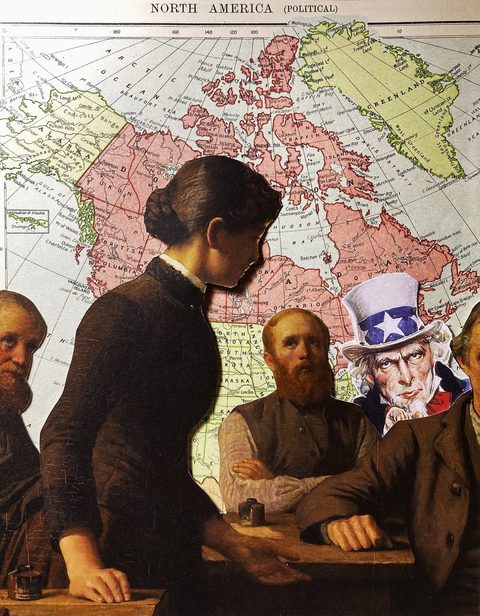
To survey a territory, name it, print it and sell passage to it is the same imperial attitude towards a woman’s body: measure, qualify, make available. In The School Trustees a schoolteacher faces her board of trustees (and an ominous Uncle Sam) over a map of North America; in Cheap Excursions a woman in a green dress sits against a railway notice offering the North West to any who can afford passage.
The landscapes come later. Figures from the annuals and from European Impressionism are set into paintings by Tom Thomson, made between 1915 and 1917, and by the Group of Seven painters Lawren Harris, Franklin Carmichael and F. H. Varley, made between 1919 and 1931. Almost none of them contain a person. Set down in that country the figures do not turn decorative again. Clytemnestra keeps the sword John Collier gave her in 1914. Nothing is retouched to look like a single picture.
The artist
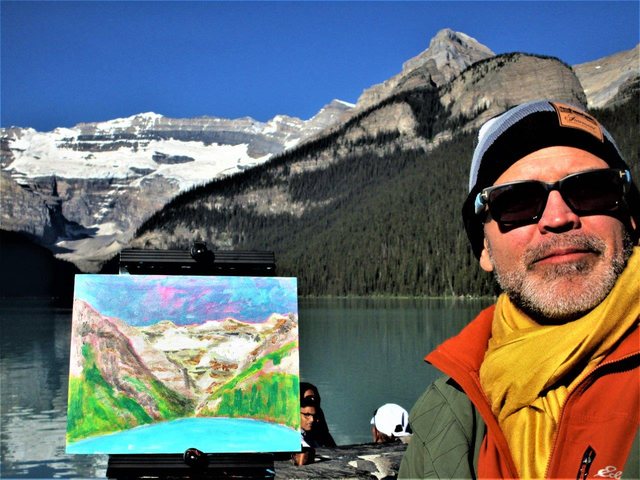
Michael Strangelove lives and works in Ottawa. He holds a Ph.D. from the University of Ottawa and has written five books on media, piracy and the internet: How to Advertise on the Internet (Strangelove Press, 1994); three with the University of Toronto Press — The Empire of Mind: Digital Piracy and the Anti-Capitalist Movement (2005), Watching YouTube: Extraordinary Videos by Ordinary People (2010) and Post-TV: Piracy, Cord-Cutting, and the Future of Television (2015); and The Value System: The Internet and Radical Change in a Time of Crisis (2017). The Empire of Mind was a finalist for the Governor General’s Literary Award for non-fiction in 2006; Watching YouTube was nominated for the Gertrude J. Robinson Book Prize in 2010.
The printed matter he spent a career studying is the printed matter he now cuts up. Women in the Victorian Imagination is his first solo exhibition.
Michel Foucault, The History of Sexuality, Volume 1: An Introduction, translated by Robert Hurley (1978). On the unpeopled Canadian landscape: Jonathan Bordo, “Jack Pine — Wilderness sublime or the erasure of the aboriginal presence from the landscape,” Journal of Canadian Studies 27, no. 4 (1992–93); John O’Brian and Peter White, eds., Beyond Wilderness: The Group of Seven, Canadian Identity, and Contemporary Art (McGill-Queen’s University Press).