About
The Body and the Territory: Michael Strangelove Reimagines the Canadian Landscape
In handmade collages that bring Victorian women into the wilderness of Canadian painting, Strangelove examines the entangled histories of gender, empire and the land.
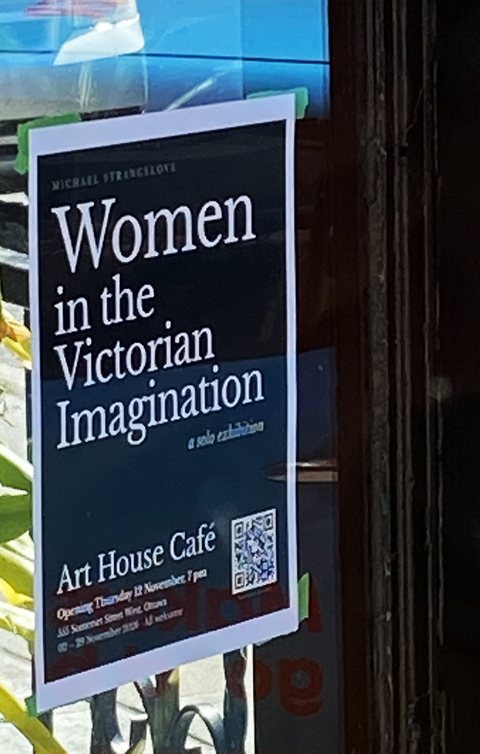
Women in the Victorian Imagination
Michael Strangelove
Art House Cafe, Ottawa
November 2–29, 2026
Who gets to occupy a landscape? Who gets to possess a body? In Women in the Victorian Imagination, Ottawa artist Michael Strangelove brings these questions together through a series of hand-cut collages that place women drawn from Victorian and Edwardian art into Canadian landscapes. The resulting images unsettle two familiar conventions: the idealized female figure, presented for the viewer’s pleasure, and the apparently empty wilderness, presented as a territory awaiting discovery and possession. By bringing these visual traditions into collision, Strangelove proposes that the way we imagine women and the way empires use land may be more closely related than they first appear.
The collages are made from contemporary, vintage and antique printed matter: century-old books, magazines, encyclopedias, atlases, railway notices and newspaper advertisements. Strangelove’s process is resolutely physical. He tears, cuts and rearranges images whose original contexts are inseparable from the cultures that produced them. Their fragments become the vocabulary of new visual narratives, while their accumulated age and material presence remind us that images have histories beyond what they depict.
Much of the source material dates from 1890 to 1915. Two principal sources are Canada’s The Dominion Illustrated, 1889, and London’s Royal Academy Pictures and Sculpture, annual volumes reproducing the exhibitions of the Royal Academy. Together with contemporary art books, these publications supply a repertoire of female figures that once circulated through the illustrated press and the art market: allegorical women, nymphs, queens, housemaids, ballerinas, schoolteachers, princesses, barmaids, mermaids, bathers and brides. They inhabit different social positions and mythological roles, but all have been made available to the viewer through conventions of representation that assign meaning to the female body.
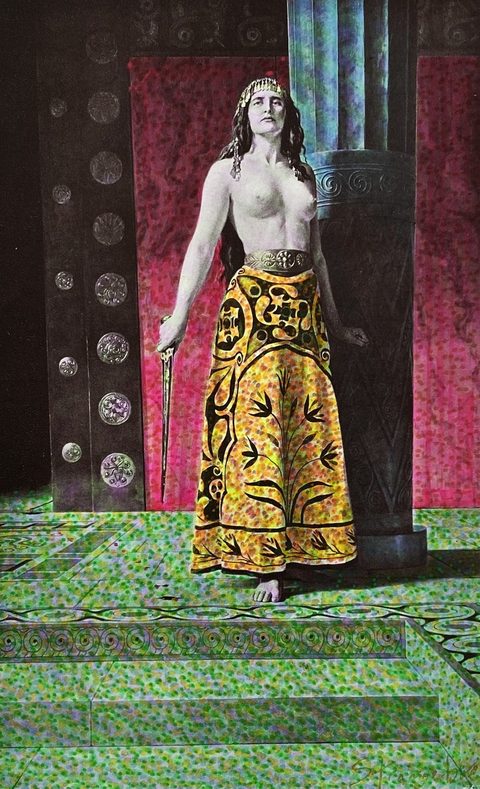
The women in these images are not simply passive victims of Victorian convention. They can embody beauty, wealth and social respectability, but also intelligence, literacy, authority, strength, resistance and vengeance. Their significance lies partly in this contradiction. A woman may be presented as an object of desire while simultaneously representing a force that exceeds the terms of that desire. The body becomes a contested site, shaped by social expectations yet never entirely contained by them.
Michel Foucault’s account of the body as saturated with sexuality offers one framework for understanding the imagery, although Strangelove’s collages suggest a broader field of power. The female figure is not merely eroticized; she is classified, idealized and assigned a place within a social order. The question is not only how women were seen, but how the act of seeing helped establish what women were expected to be. By cutting these figures out of their original settings, Strangelove interrupts the authority of their inherited meanings. Yet displacement does not automatically confer freedom. A figure may acquire new possibilities in a collage while retaining traces of the conventions from which she came. It is in this tension between constraint and agency that the series finds much of its critical potential.
Strangelove extends this inquiry by placing Victorian and Edwardian women into landscapes by Tom Thomson, Lawren Harris, Franklin Carmichael, F. H. Varley, and Emily Carr. These paintings, made between 1915 and the early 1930s, belong to a formative period in the development of a modern Canadian landscape tradition. Their mountains, forests, waterways and rocky expanses helped establish a powerful visual vocabulary through which a new country could imagine itself. Yet the landscapes selected by Strangelove almost never contained human figures. Their apparent emptiness is central to his intervention.
What happens when a woman from a Victorian painting enters this ostensibly unoccupied territory? The juxtaposition makes visible a parallel between two representational conventions. The female body, idealized and made available to the viewer, and the land, pictured as empty and available for acquisition, are both transformed into objects of the imagination. Strangelove’s collages suggest that these are not unrelated habits of looking. Both involve a process of selection, classification and possession: the conversion of something complex into something that can be named, desired and claimed.
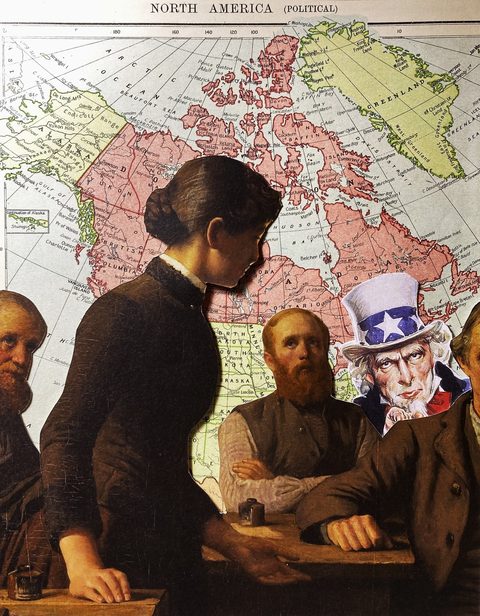
This argument becomes particularly legible in The School Trustees and Uncle Sam. A schoolteacher faces her board of trustees, with an ominous Uncle Sam looming over a map of North America. The arrangement brings education, female authority, and continental power into a single visual field. The map is more than a geographical reference; it evokes the political and institutional forces that organize territory. The teacher, meanwhile, occupies a position of authority within a social structure that seeks to regulate her. The work’s juxtaposition invites us to consider how apparently different forms of power intersect, and how the female figure may be subject to institutional control yet retain her own agency.
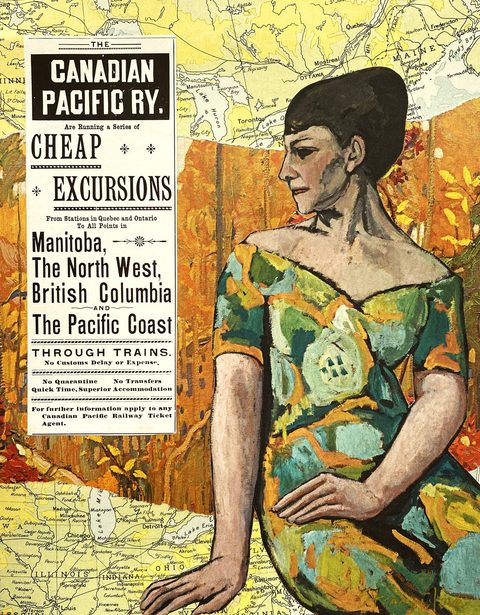
In Cheap Excursions, a woman in a green dress sits against a railway notice advertising passage to Canada’s North West. Here the relationship between body and territory becomes more explicitly commercial. The railway notice turns geographical distance into a purchasable experience, presenting the land as accessible to those who can afford the journey. Beside it, the woman becomes part of a visual economy of availability and exchange. The composition draws a parallel between the commodification of territory and the cultural presentation of women as objects of consumption. Both are framed through promises of access.
These juxtapositions are provocative because they expose the ideological work that images can perform without announcing themselves as political arguments. A railway notice may appear to offer nothing more than practical information; a painting of a beautiful woman may seem to provide nothing more than aesthetic pleasure. But both participate in systems of value. The notice makes land legible as a destination and a commodity. The Victorian woman reflects conventions of beauty, desirability and social position. Strangelove’s intervention asks us to look beyond the immediate appeal of such images to the assumptions that make their appeal possible.
The Canadian landscape tradition gives this inquiry a further dimension. To describe a landscape as empty is not simply to describe the absence of human figures in a painting. It can also reproduce a historical imagination in which land appears available for settlement, development, and possession.
Canada’s landscape painting cannot be separated from the histories of Indigenous presence, sovereignty and dispossession that complicate the idea of an unoccupied wilderness. Strangelove’s “Terra Non Nullius” series of collages raise questions about the visual conventions through which territory has been imagined, although the relationship between the paintings and these histories deserves careful consideration. The absence of figures in a landscape is an artistic convention, not evidence that the land itself was uninhabited.
This distinction matters because the series is concerned not only with what images depict but also with what they leave out. By inserting European women and indigenous people into landscapes that once excluded human figures, Strangelove disrupts the apparent neutrality of the original compositions. Their presence exposes the constructed nature of the landscape image and invites a reconsideration of who belongs within it, who has the authority to represent it, and who is permitted to claim it.
The handmade process reinforces this critical approach. Unlike digital collage, in which images can be combined without direct contact with their material sources, Strangelove’s method requires him to handle the historical printed page. The act of cutting is an act of selection, and the act of reassembly establishes relationships that did not exist before. The resulting images are neither faithful reproductions of the past nor entirely new creations. They occupy the space between inheritance and intervention, retaining traces of the visual cultures from which they emerged while exposing those cultures to fresh scrutiny.
Women in the Victorian Imagination ultimately proposes a different way of mapping the Canadian imagination. By bringing British and European representations of women into conversation with Canadian landscape painting, Strangelove unsettles the inherited visual conventions through which both femininity and territory have been understood. The resulting images suggest that neither the body nor the land is ever simply given to us. Both are mediated by cultural histories, artistic choices and structures of power.
The new territory Strangelove constructs is therefore not an untouched wilderness but a landscape of competing meanings. Its contours emerge from the fragments of a printed past, rearranged to reveal the assumptions that have shaped our ways of seeing. The collages do not resolve the contradictions between objectification and agency, or between landscape as aesthetic experience and land as contested territory. Instead, they make those contradictions newly visible. Their most enduring question is also their simplest: when we look at a body or a landscape, what have we already been taught to see—and what might become possible if we learned to see otherwise?
The artist
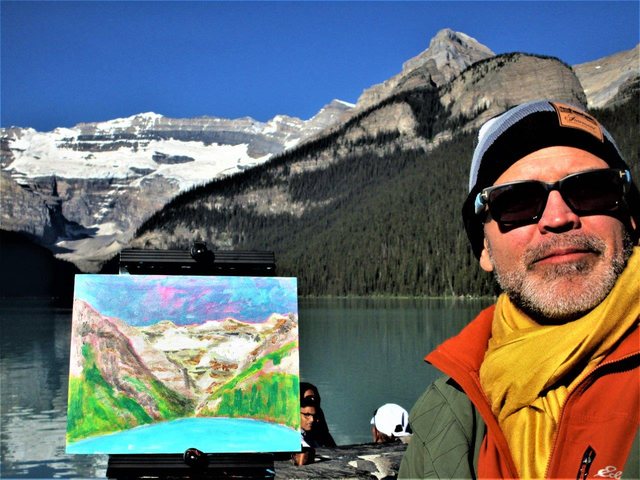
Michael Strangelove lives and works in Ottawa.
He was studying for the Baptist ministry when he left bible college in 1982 and hitchhiked west to Banff. There he took life-drawing classes, joined the local amateur theatre company, and began sketching the Rocky Mountains.
He founded a publishing and consulting company in 1993 and wrote the first book on how to advertise on the Internet in 1994. His books for the University of Toronto Press have taken up digital piracy, amateur video, streaming television — and the artists who remake Barbie. The Empire of Mind was a finalist for the Governor General’s Literary Award for non-fiction in 2006.
He paints plein air across Canada when he travels.
He has taught at the University of Ottawa for twenty-six years. His students disconnect from the digital world, make collages, and sharpen their thinking by working with their hands.
The printed matter Strangelove spent a career studying is the printed matter he now cuts up. Women in the Victorian Imagination is his first solo exhibition.
Michel Foucault, The History of Sexuality, Volume 1: An Introduction, translated by Robert Hurley (1978). On the unpeopled Canadian landscape: Jonathan Bordo, “Jack Pine — Wilderness sublime or the erasure of the aboriginal presence from the landscape,” Journal of Canadian Studies 27, no. 4 (1992–93); John O’Brian and Peter White, eds., Beyond Wilderness: The Group of Seven, Canadian Identity, and Contemporary Art (McGill-Queen’s University Press).