in wooden ships
with iron cannons
they came from away
and pointed
to the ground and said
this land is now
our land
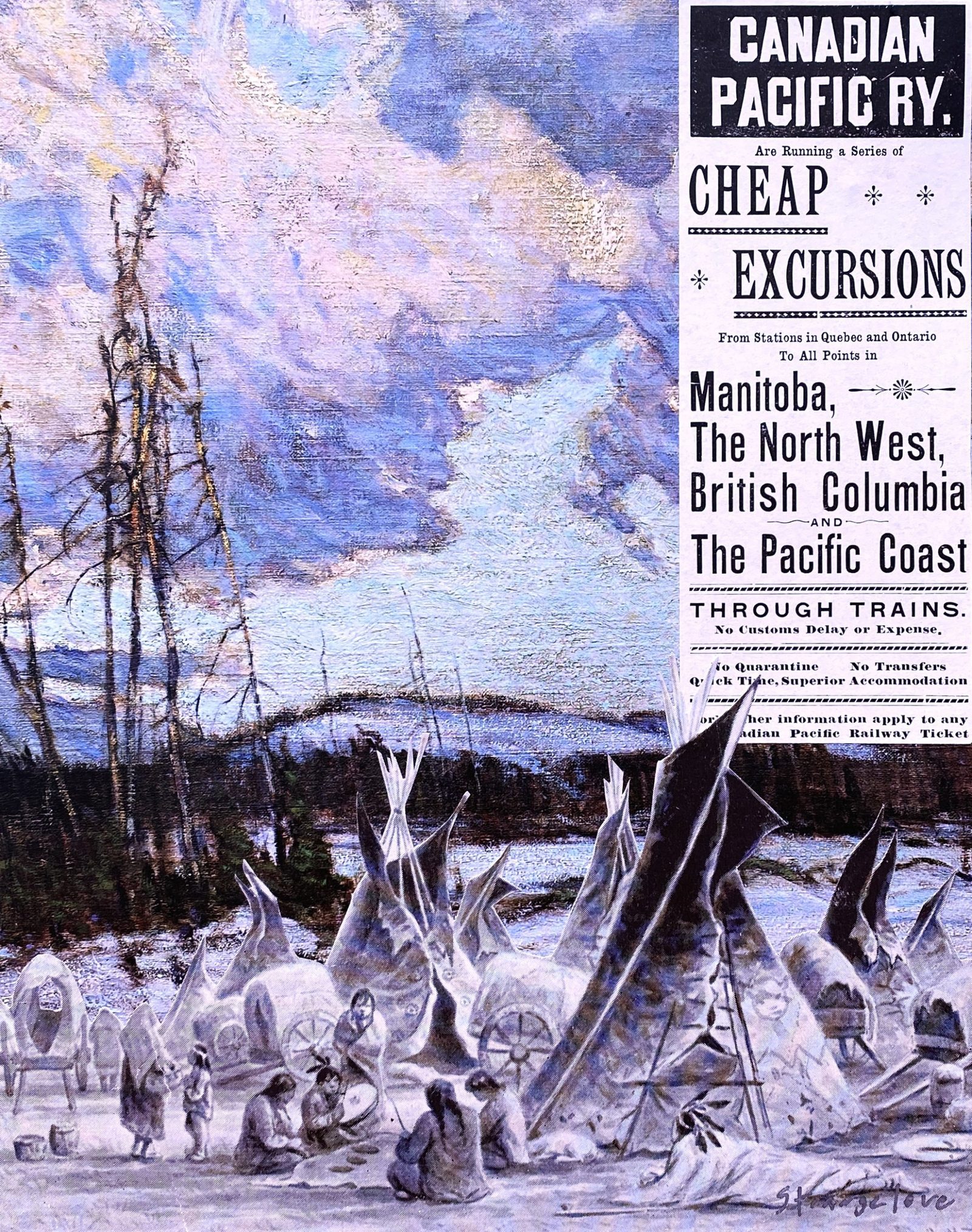
Combines J. E. H. MacDonald's March Evening, Northland (1914) with a drawing by Frederick Arthur Verner, 1836–1928, the Canadian painter of encampments and bison — “Encampment of Blackfeet Indians,” a wood-engraved encampment of tipis, Red River carts and seated figures, cut from The Dominion Illustrated of 12 January 1889 — and a Canadian Pacific Railway advertisement for “cheap excursions” from stations in Quebec and Ontario to Manitoba, the North West, British Columbia and the Pacific Coast, cut from The Dominion Illustrated of 6 April 1889.
The story
The title turns a Latin phrase inside out. Terra nullius means land that belongs to no one, the idea that a place with no recognised owner can simply be claimed. Terra non nullius says the opposite.
Three printed sources meet here.
The landscape is J. E. H. MacDonald's March Evening, Northland (1914), in the National Gallery of Canada. MacDonald was a founding member of the Group of Seven, and this is the north as those painters liked it: snow, bare trees, a huge sky, and no one in sight.
The camp along the bottom is a wood engraving, "Encampment of Blackfeet Indians," after Frederick Arthur Verner (1836–1928), published in The Dominion Illustrated on 12 January 1889. Verner was born in Ontario and became known as a painter of Indigenous peoples and of bison, and he had moved to London in 1880. The caption uses the old English name for the Blackfoot, whose confederacy is made up of the Siksika, Kainai and Piikani. In September 1877, at Blackfoot Crossing on the Bow River, they signed Treaty 7 with the Tsuu T'ina and Nakoda, opening about 50,000 square miles of what is now southern Alberta to settlement.
The advertisement at top right is from the same magazine, the issue of 6 April 1889. The Canadian Pacific Railway offered "cheap excursions" from Quebec and Ontario to Manitoba, the North West, British Columbia and the Pacific Coast. The line it was selling had crossed Blackfoot land only a few years earlier. The Blackfoot had opposed it. After moving to Calgary in 1882, Father Albert Lacombe negotiated an agreement with Crowfoot that let the railway cross, and the CPR's president, William Van Horne, gave Crowfoot a lifetime pass. Track reached Calgary in August 1883, and the line was finished in 1885. Crowfoot died in April 1890, a year after the advertisement ran.
Canada never formally treated the land as empty. The Royal Proclamation of 1763 recognised that Indigenous peoples held it, and the numbered treaties were signed because someone had to sign them. In 2014 the Supreme Court said in Tsilhqot'in Nation v. British Columbia that terra nullius never applied in Canada. The collage puts the camp back into the gap the painting leaves.