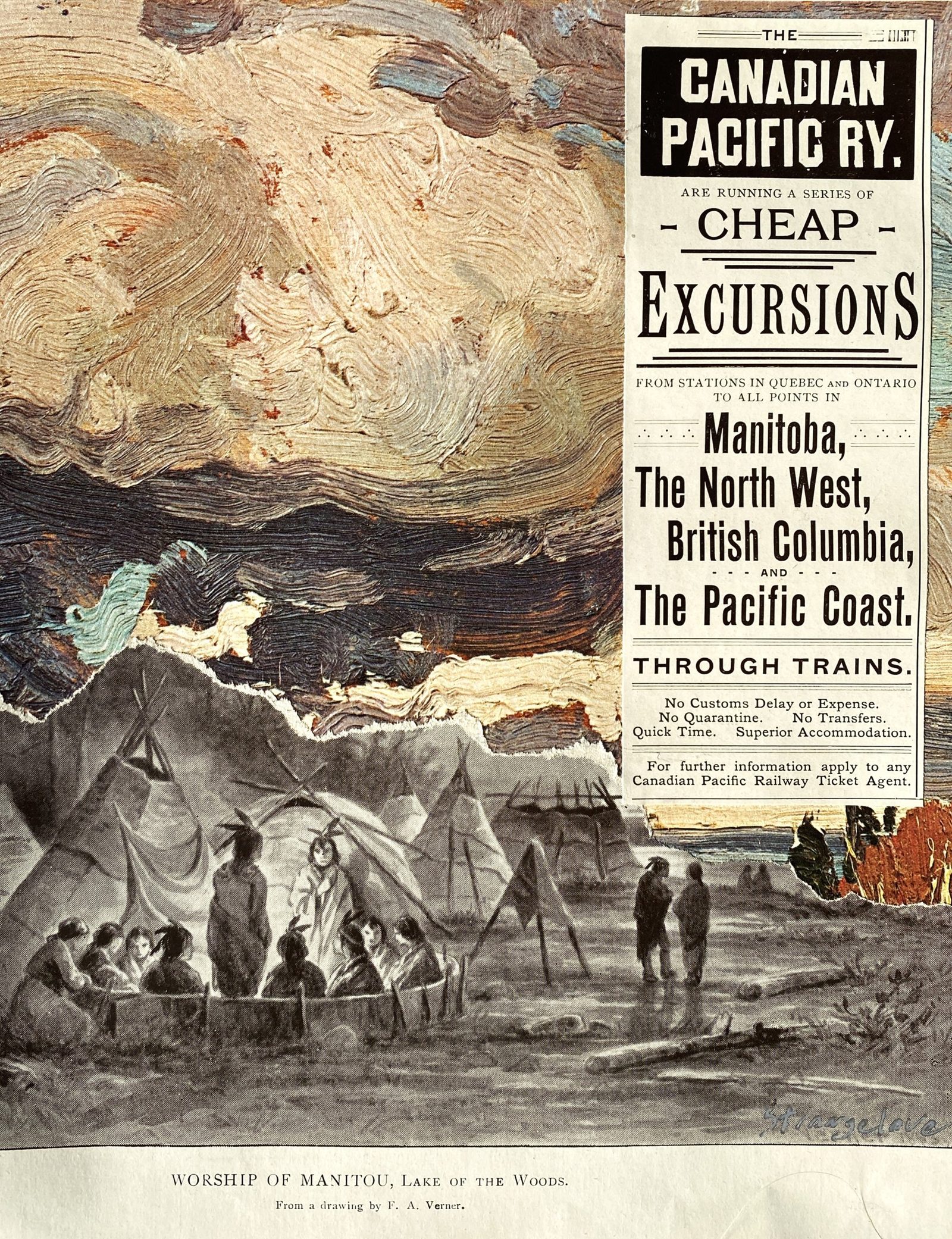
the hand of empire
built an iron rail
and drove a spike
into the heart of the sacred
in the name of
cheap excursions
The story
Three sources meet on a single 9.5 by 7.5 inch sheet. At the top, a painted sky from Tom Thomson's Tea Lake Dam: thick, swirling strokes in ochre, slate and pale blue, reproduced so the brushwork still reads as pigment. Across the right edge runs a Canadian Pacific advertisement, its black masthead and condensed type announcing cheap excursions to Manitoba, the North West and British Columbia, with the promise of “No Customs Delay or Expense.” Below, a tent camp from F. A. Verner's drawing Worship of Manitou, Lake of the Woods, printed in grey and torn ragged along its upper edge where it meets the sky.
The composition works in layers. The advertisement sits over the scene the way the railway sat over the country it sold. Its type is the loudest thing on the sheet, and its message, that the West was open for visitors, sits uneasily beside the treaty the drawing's landscape came out of. Verner's figures are small and quiet in the lower left, almost lost in the grey tones; the advertisement is hard-edged and bright. Set side by side, they ask who the land belonged to and who was selling it.
The sky does the emotional work. Its turbulence stands against the advertisement's printed certainty, and the eye moves between them without settling.
The poem given as the wall text makes the argument plainly: “the hand of empire / built an iron rail / and drove a spike / into the heart of the sacred / in the name of / cheap excursions.” Its last line is the advertisement's own phrase, handed back to the viewer as an accusation. The signature in the lower right is a small, deliberate mark of authorship on a sheet built entirely from other people's work.