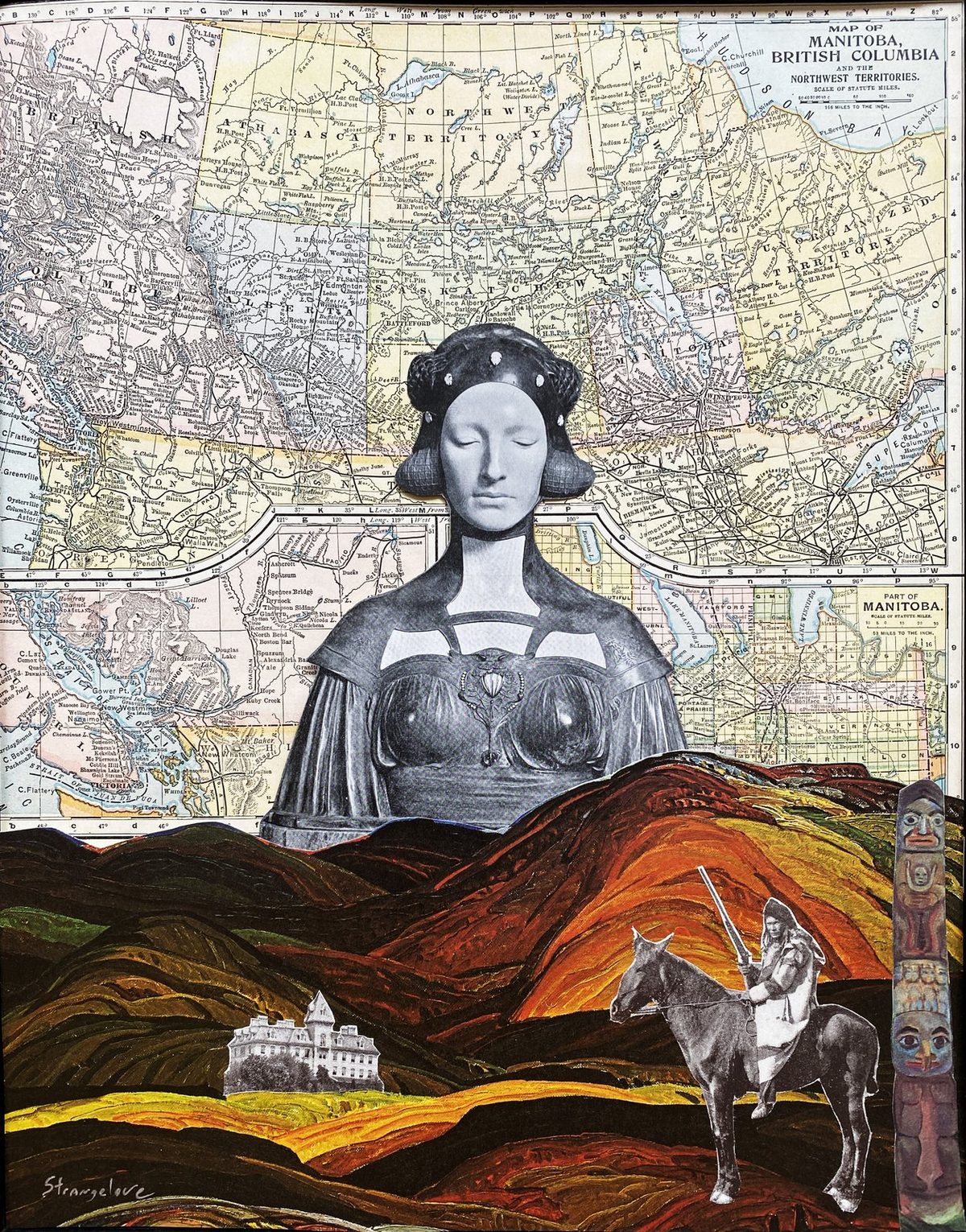
Lamia
cursed by Hera
forever to hunt
kidnap
devour and
kill children
their bones
buried beneath
this stolen
land
Combining fragments from an 1889 map of Canada (Peerless Atlas of the World) with a bust of Lamia by Sir George Frampton (Royal Academy Pictures, 1900), Franklin Carmichael's Autumn, a totem pole from Emily Carr's Corner of Kitwancool Village (1930), and from the February 2, 1889 edition of The Dominion Illustrated, a photograph of the Hellmuth Ladies' College, London, Ontario, and from the February 23, 1889 edition of The Dominion Illustrated, a photograph of Mustatum Moutiapec (Horse Roots) Cree Indian, Calgary.
The story
Six printed sources meet here.
The map is of Canada, from an 1889 atlas, the Peerless Atlas of the World.
The bust is Sir George Frampton's Lamia (1899–1900), in ivory, bronze, opals and glass, reproduced in the 1900 volume of Royal Academy Pictures and Sculpture. In Greek myth Lamia was a queen loved by Zeus; Hera destroyed her children, and she became a monster who preyed on other people's children. Frampton's bust draws on Keats's poem Lamia (1819), in which she is a serpent who takes a woman's form.
The landscape is Franklin Carmichael's Autumn, and the totem pole is from Emily Carr's Corner of Kitwancool Village (c. 1930). Kitwancool is the Gitxsan village in northern British Columbia now called Gitanyow.
Two photographs come from The Dominion Illustrated. On 2 February 1889 it printed Hellmuth Ladies' College in London, Ontario, founded in 1869 by Isaac Hellmuth, later Bishop of Huron, and opened by Prince Arthur. The college closed around 1900; its building later became an orphanage and convent and was demolished in 1976. On 23 February 1889 it printed a photograph captioned "Mustatum Moutiapec (Horse Roots) Cree Indian, Calgary."