she liked to ride
her bicycle
her metal steed
unchaperoned
womanhood freed
and unbound
clothed in rational
dress
speeding on wheels
towards full
emancipation
and delight
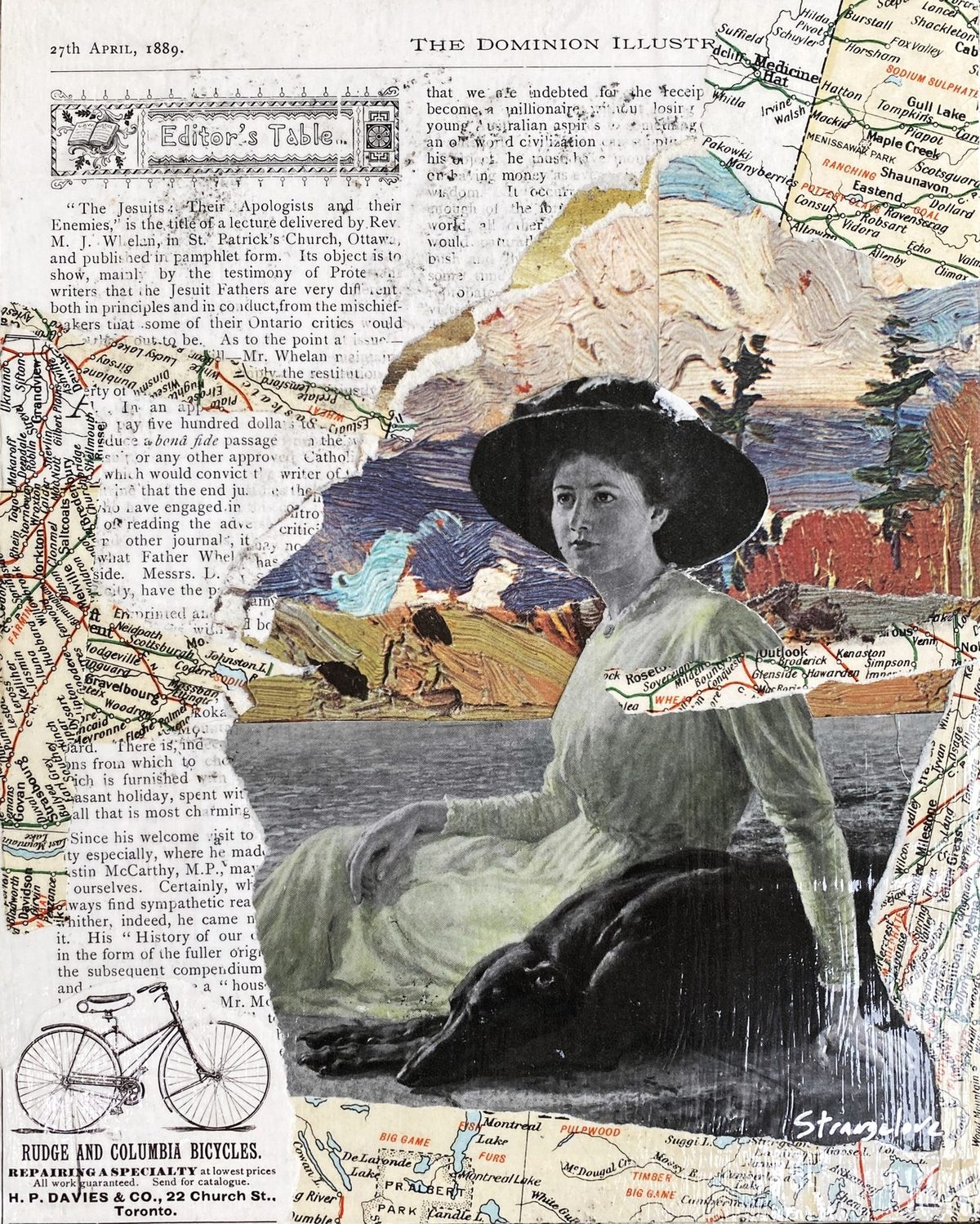
Combines fragments of Tom Thomson's Tea Lake Dam (1915) and Briton Rivière's painting of Mrs. Addison C. Riviere, A Portrait in Black and White (1910), with a fragment of an antique map of Canada and, from The Dominion Illustrated of 27 April 1889, a page of the Editor's Table and an advertisement for Rudge and Columbia bicycles.
The story
Three printed things meet here.
The landscape is Tom Thomson's Tea Lake Dam, an oil sketch painted in the autumn of 1915 in Algonquin Park. It is now in the National Gallery of Canada.
The woman is from Briton Rivière's A Portrait in Black and White (1910). Rivière (1840–1920) was a British painter best known for his animals, and a black hound lies beside her.
Under them lies a fragment of an antique map of Canada. Over them runs a page of The Dominion Illustrated, a Montreal weekly, from 27 April 1889: the Editor's Table, and an advertisement for Rudge and Columbia bicycles. Rudge bicycles were made in Coventry, England, Columbia in Hartford, Connecticut. Eight years before, in 1881, the Rational Dress Society had formed in London to argue for women's clothing that did not hold the body back.